
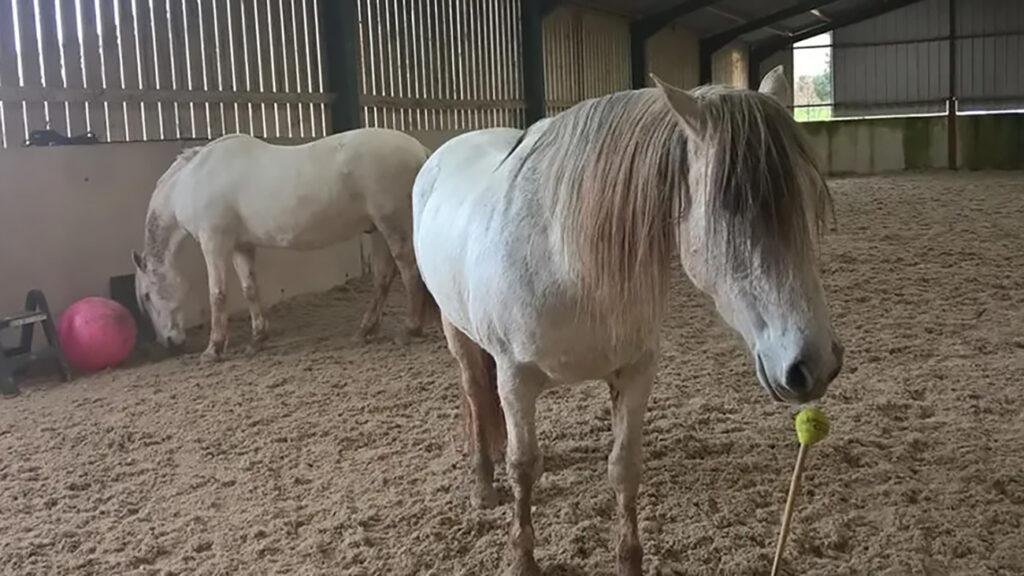
Target touching means teaching a horse to touch an object with a body part. Hoof to a mat. Hip to a hand. Often it’s their nose to a ball on a stick. The horse learns that touching the object earns reinforcement.
At first glance, teaching a horse to touch a target looks simple. Hold out an object, the horse touches it, click, reinforce. A neat behaviour, perfect to film for a quick reel.
Whoah! What looks good on a reel isn’t always best for a horse.
Too often targets are taught in a way that turns the horse into a follower of objects, not a thinker. The target moves, the horse follows. That might look like ‘training,’ but it isn’t learning. The horse isn’t making choices, isn’t experimenting, isn’t feeling for the moment when behaviour works.
This is why I don’t recommend targets as the first behaviour for beginners (horses, humans or both). Targets can easily mask poor timing and mechanical skills. If you start with a target before you’ve learned to see and respond to a horse’s subtle behaviour, you risk introducing frustration and confusion. And when the target becomes the centre of your training, the horse can’t be.
That doesn’t mean targets are useless. Far from it.
For a horse who is struggling in a new environment, it might offer confidence in the pattern of ‘touch this, gain reinforcement.’ For the shut-down horse, it might reignite curiosity when they find that their behaviour can gain a desired outcome. I’ve used targets to help horses take a step. To place their nose in a certain direction. To add a tactile rein cue. In those moments, the target isn’t the desired behaviour, it’s a prop that suggests it. And like any prop, it’s not meant to stay forever.
That is the kind of target training I love. Situations where the target suggests a behaviour. It works like a lure. It says, ‘come this way’, ‘do this thing’. But beware confusing the prop with the process. A target is only as good as our timing and the ability to fade it. When we carefully fade a target we might present it for less time or at a further distance until we finally remove it entirely, so the horse learns to respond to our cues rather than the prop.
That’s why you won’t find many photos of me holding one. Targets come out when they serve a purpose, and then they are faded.
A horse following a target might look cute to a reel audience, but the depth is missing. True training isn’t about cute. It’s about communication.Because a target isn’t the behaviour. It’s a small part of the training: a prop, a tool.